The phobia of normal life is a phase 3 phobia that is intertwined with the phobia of change, like two sides of the same coin. While we often long for normal life in earlier phases, suddenly the reality of it becomes overwhelming. And the reason is not the trauma memory anymore. At this point in our recovery journey we have realized that most of our phobic avoidance was a protection from the overwhelm of the traumatic memory and its effects. After trauma processing, it does not seem to make sense to still experience phobic avoidance but here we are. There is still a real danger of overwhelm, just not from memories. Our focus shifts from the inside world to the outside world and we start to experience overwhelm from what is waiting for us outside our own mind.
The chaos we know
Before trauma processing, our whole life is organized around the trauma. It defines our options for us. We have to stay away from certain situations to avoid getting triggered. Someone who e.g. faints when people are clapping will avoid not only concerts but any kind of performance and any kind of speech. Huge areas of normal life vanish from the map of what is possible. We usually added situations to the list that cause dysregulation because they are too stressful for our damaged nervous system. So a lot of fun activities are gone from our map because the excitement feels too much like hyperarousal and we can’t manage it safely.
Instead of normal life activities we know a whole lot that center around symptom management. We spend quite some time on organizing our inner system and making sure everyone is ok, which is a really difficult skill to learn. What we carry with us in our purse might be chosen for its abilities to get us out of a stressful situation. We don’t have a normal life. Most of what we do is meant to balance our system or our nervous system in some way and it might take up so much of our energy that we can’t do things other people do daily, like going to work. Our Normal Life is formed by the effects of trauma and defensive actions. We survive and we protect ourselves. And then the trauma at the center of our life gets resolved.
Shifting balance
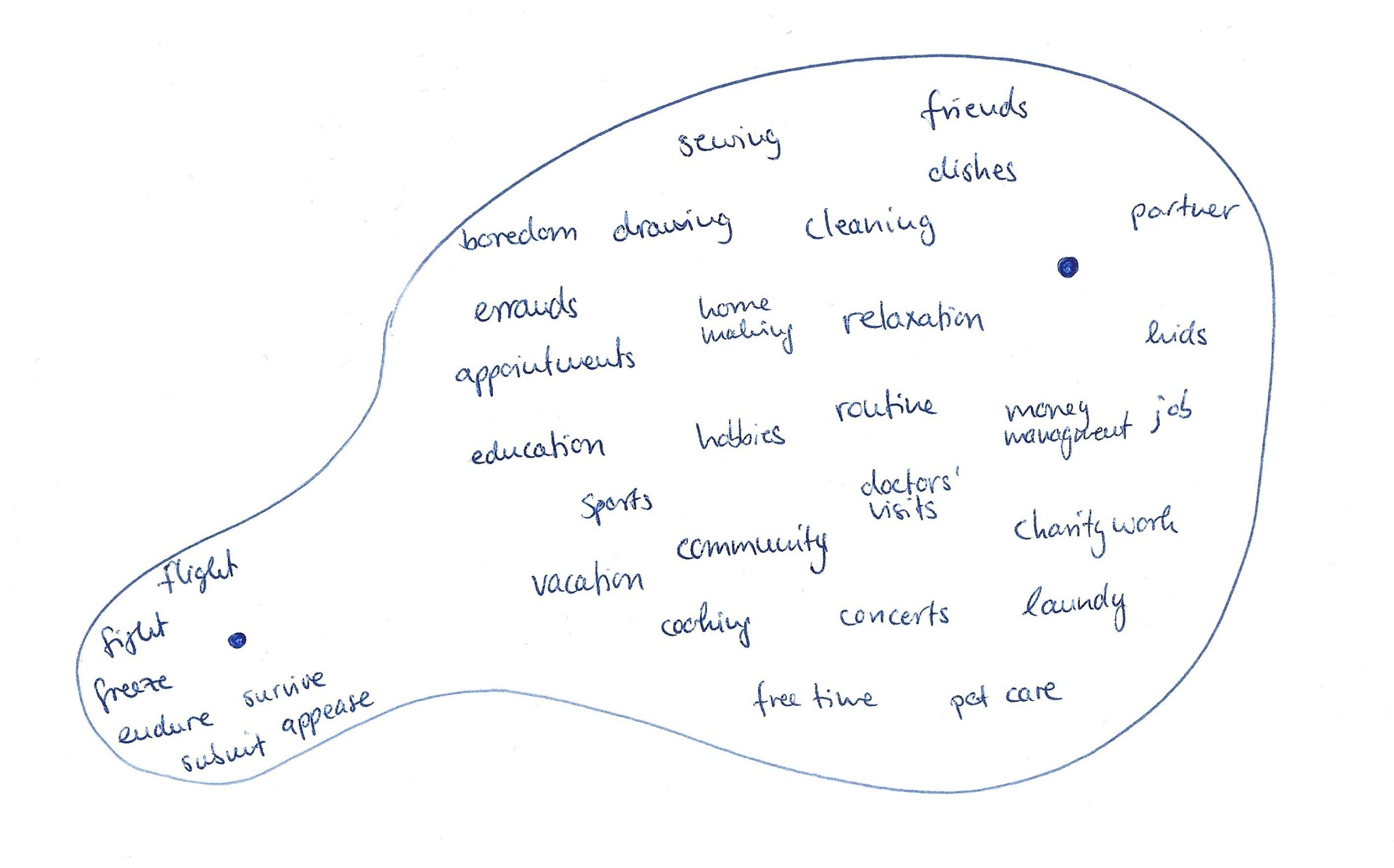
After trauma processing, the center of gravity in our life shifts. There is no reason to build a life around the effects of trauma anymore. Triggers stop triggering, they just become reminders and eventually they lose their meaning. We face less and less stress responses. Our skills to manage even severe dysregulation become superfluous. We don’t have to keep out bad things anymore, we could start to let in good things. At the same time we experience normal functions that have been buried for a long time, like normal, healthy emotion that does not trigger traumatic emotion. The skills we learned to manage emotions have become overkill but we also don’t know how to do normal emotions yet. We will return to an equilibrium but for a good while everything will feel off balance and what we know about managing life isn’t as useful anymore. Some people pick things up with ease and the process will be an adventure. But it can also feel like a small shock to realize how unprepared we are for doing normal things. Our whole system moves out of defensive actions that we know really well into the action systems that are usually somewhat covered by ANPs. But even ANPs only know a small percentage of normal life actions because they never did any of it in an integrated way with access to all emotions, memories or body sensations. Life starts to feel unfamiliar and off. Estranged feelings are normal because normal life is new to us and the reality we have been living in is gone. This new one has a lot in common with the old one but everything feels at least slightly off at the same time because our internal balance has shifted entirely. There is a phase where this shift is incredibly hard to get used to and outside people don’t seem to understand why. Integrated actions of normal life are strange for all of us. Suddenly we are not surviving anymore, but what are we doing instead?
Look at the graphic and imagine how the shape would be oriented if the left dot was the center of gravity. How would it shift if the right dot became the center of gravity?
EPs and normal life
In trauma processing, there are often situations where elements of the past are sorted into the past and parts change as a result of that. Past events become less of a current reality and more of a memory. The realization of the current world can come with all kinds of reactions, from huge excitement to deep shock. Now we are also shifting the balance so that the actions parts were involved in only ever show up in situations with real life-threatening danger. Their whole world is changing. It can work out in many different ways. Maybe the realizations and presentification lead to spontaneous integration or fusion and the part won’t feel so part-y anymore. They might stay more separate and go through a process of transformation where they adapt to the new life situation. Sometimes losing the past reality is a welcome relief and the new world is full of adventure. In some cases parts might enter complicated grief and start to sabotage everything that has to do with normal life because they don’t want it, they want their trauma life back. Attached to that behavior are very real needs that have nothing to do with a seeming need for trauma. They need very close relational support through this change. Right now they are a refugee in this new world and they feel like they know nobody and nothing anymore. All that they are good at is worth nothing here. They should at least have us and our deep love and compassion. Moving to normal life is hard. They got stranded in a reality that has never been their own.
Overwhelm
This deep shift of balances inside can lead to overwhelm. Nothing prepared us for it properly. We had no way of even guessing how it would feel like. We can’t even hide inside our homes and stick to routines that have lost their meaning. The change is so much part of us that avoiding the outside world does not help. It is still important to find a way to pace our journey into the normal. Overwhelm has always been our enemy in our adventure of overcoming dissociative phobias. It is still the one we struggle with after trauma memory is resolved. When we notice overwhelm, we stop overwhelm. At this point, our best strategy for that might be distraction. Our signs of overwhelm will be psychological distress more than physiological stress responses and we need to adapt our tools a little bit. Weirdly enough, the self-soothing tools that we might have struggled with for years like body scans, guided imagery or breathing exercises start to become really effective now, even if they weren’t helpful before. Some of our old skills will feel like overkill and stop making sense to us. The toolbox we carry will change significantly and that is normal. We need smaller and more specific tools now that we experience more nuance.
What is thinkable
How do we pace ourselves best? I am not entirely sure. It is not a smooth process in real life. I believe that therapists should not pressure us to do more normal life things. Avoiding them might still serve the purpose of protecting us from overwhelm. I think it makes sense to build up new skills and test them in small situations. We still need help and we still need to learn how to cope with normal life. Therapy is far from over.
Here is my prefered approach: I expose myself to the world around me in small steps, just to take in what the world is like when I am not always in survival mode and what I am like when I am in the middle of normal life. Just being outside in the world does something. There is always an interaction between a being and the world around them and just being somewhere has an impact. Then I notice the things that become thinkable. For a long time I was too busy surviving to notice what other people were doing or how they looked. Now I might notice a cool haircut and a new thought pops into my mind. What if I had a pixie cut? Hair might not have been something I have thought about since my teenage years and I just managed it somehow. Now something new becomes thinkable. Becoming thinkable is a clear sign that change has already happened. Even before we actually did something, it has come into existence in our life. Something that is normal has made its way in. I try to notice every time something new becomes thinkable that has not existed in my life before. Over time, there will be new ideas about pets, travel, going to a concert, doing something fun for the sake of fun, playing, engaging with new people, looking for a partner or intimate relationship… things slowly become thinkable and this natural development of allowing them to pop up as they do is a natural pacer that keeps us from overdoing it. We don’t have to force ourselves to do the still-unthinkable things. We don’t even have to do the thinkable ones right away. We can just entertain the fact that they are becoming more and more thinkable and therefore doable. We might still face the reality that too much is becoming thinkable at once, so keeping up with ourselves is difficult enough without adding unthinkable projects.
Grief
As our psyche opens up more and more options of thriving we will notice the fact that we had none of that in the past and that they have been unthinkable for a good reason. We should expect grief to be our steady companion in our journey to normal life. We will notice all the time we have lost and all the good things we have missed. Most of it will be impossible to repeat now.
And there will be a loss that might be unexpected. Maybe we always thought that once we get the trauma out of the way we will live a peaceful and happy life. But life is not a paradise and it isn’t even fair. We will face some effects of trauma that are irreversible like some chronic pain or a lasting impact on our personality. And we will learn that normal life holds tremendous amounts of stress, disappointment, struggle and injustice. Maybe we have worked towards a better life but the life we get might still sucks big time. We find small joy and happiness, maybe in relationships or in nature, but all of life is not fantastic. We put in so much work just to end up in a world where all people struggle to survive capitalism, poverty, racism, bullying at work, sexism and misogyny. The world isn’t even half as safe from that as our Ts might have suggested when they said that looking around was a good strategy to feel safe. We don’t live in TraumaTime anymore but Today isn’t all cupcakes and unicorns either. And that feels like a loss.
The problem of capacity
The phobia of normal life is not a weird phobia of getting better. These steps are bigger than any we have ever taken. They are bigger than trauma processing. I use the image of a big suitcase for integrative capacity. At the beginning of our recovery we try to put extra socks in the suitcase and stretch it enough so it adapts. By the time we enter phase 3 we try to put whole items off furniture into that suitcase and hope that is acts like Mary Poppins’ bag. The shift in the center of gravity within our system is a shift of our whole world and reality. Realizing the world around us leads us to realizing our new options in this world and that is freeing and beautiful. It also confronts us with a great number of new experiences that we don’t have skills to work with yet and it is highly demanding to catch up on those, all while feeling waves and waves of grief about the not so normal life we used to have and all the missed opportunities. Be gentle with yourself. This might be the hardest part of recovery and nobody warned us properly because they were so focused on memories and processing something. The big integrative tasks happen later and they are bone-deep and soul-changing.
Alienation
People don’t praise our adaptation to trauma, they praise our re-adaptation to normal life. But maybe we won’t re-adapt. Maybe we have done enough and we don’t get the couch to fit into our suitcase because that is absurd. Maybe there is no pretty ending that others could praise and we won’t find a home in normal life and integrate properly. There is a disconnection from the world and normal life that can happen after the experience of extreme physical pain. We walk through normal life but there is a missing link that we can’t find anymore. We live in a world that we can’t belong to anymore, almost like we are in color but the world has turned black and white. We can find our own moments in solitude that color in our environment a little bit. I recommend having pets and being in nature. It is not a given that we find the connection to normal life or other people again, even if we move through the tasks of a normal life. I believe that Alienation is an extreme form of derealization that protects us from heart-break. Some kinds of grief might be too big to survive them. Parts who experience alienation should not be forced to engage with the world after it is clear that they can’t find the connection. It will be more adaptive for them to find a place inside that brings them peace and where they are not re-experiencing anything. A capsule of alienation inside the system does not disrupt further integration, it might make it possible. It is important to honor the parts that hold what cannot be realized without crushing us. This outcome is a reality I don’t want to hide from anyone. Sometimes incomplete integration is the only possible integration and not all of us enters normal life. When a system as a whole stays alienated there is a high risk of suicide even after all the trauma work is done. A true connection to normal life is what keeps us in this world. It doesn’t even have to be stable. It is needed to be alive.
[I struggled to find any professional information about the integration phase that was more than superficial. My goal is to at least offer peer insight for those who feel lonely during integration. This article is based on the theory in The haunted self (Steele, Nijenhuis, van der Hart) and my own experience. If you are in this late phase and you want to contribute your own experience, please comment below.]